
Battery Care Tips for Every Season
Winter deep-freezing temps are very hard on batteries, and summer extreme heat is, too. Both weather extremes can strike out of the blue, and when that happens, you’re forced to scramble. To make sure your car battery is strong and ready for action, we regularly test it and will recommend replacement when it shows signs of weakness, so you’re not surprised by needing a tow or a jump-start.
Here are a few tips for battery care based on various types of failure we often see. Sometimes, even after a new battery has been installed, the same problem persists; this short list offers a few reasons why.
1. Loose terminal connection. Tip: after connecting cables to a new battery, wiggle the terminal aggressively to try to remove it. If you can't remove it, you're OK. If it’s moving or it pulls off, do it over until it holds good.
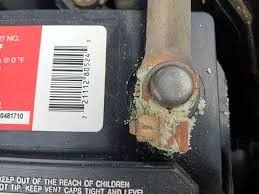
2. Some batteries develop acid leaks, and when they do, the whole mess needs to be cleaned up and neutralized to restore a strong electrical connection to the car. I say this because of how many NEW batteries we see installed with pretty bad corrosion and acid-soaked "fuzz" all over the cable ends.
3. If an acid leak is real bad or it keeps leaking again after cleanup, then the battery just needs to be replaced regardless of how well it tests. Learn how to deal with battery corrosion here.
4. Sometimes the battery was never at fault: bad starter, bad alternator, there's a second battery for Auto StopStart that can also be bad. (Chrysler/Dodge/Jeep). Or the wrong type of battery was installed. Testing will confirm the health and state of charge of the battery and if it’s ok, then test other parts of the electrical system to determine the root cause of a no crank no start problem.
5. Sometimes the no-start isn't a cranking problem. It's cranking, turning over just fine, but won't fire. In this case, if you crank and crank and crank, repeated attempts to start an engine that refuses to run, the battery will loose it's finite charge and go dead. This is not a battery failure, the battery just needs re-charged. That being said, the engine needs another repair to fix the reason it's not firing/starting/running and this could be a fault in the Ignition, Fuel, or other system problem.
6. And finally, another common issue is vehicles that aren’t driven very much or very often. This is often a surprise, but keep in mind that every battery self-discharges at a very low rate throughout its existence. Normal, frequent driving makes it a non-issue since the alternator will recharge it. But for cars that sit parked most of the time, the tiny self-discharge rate outweighs the recharging from the few short drives, so they end up very low on charge. This is very unhealthy for the battery, too, where even a full recharge can’t restore capacity. For example, 3-minute drives to work and shopping, 4 days a week, or only short drives once a week. This type of very low utilization doesn’t provide enough vehicle running charging time to keep a battery fully charged.
It takes many months for this cumulative distress to finally overcome a good battery capacity, so it usually sneaks up on owners. Often, it’s a year or two to fully manifest in a new battery, so it’s easy to think it’s something else that just recently occurred when, in this case, it’s been brewing for over a year. A battery's state of charge will decrease significantly before its resting-state voltage drops very much. So, by the time the surface voltage drops below 11.7 volts, the battery is at 10% state of charge, dangerously low. In ideal conditions, it could still start the car, but with even a small additional stress, it will fail.
The new fully charged batteries' resting state voltage is 12.7 volts. Weird huh? First, the resting-state voltage is only achieved after sitting with no load and no charge applied for 4-12 hours. Minimum 4 hours; it's better to let it rest overnight. The value in this test is how simple it is, a minimal tool (buy a digital meter at Harbor Freight or 2 Amazon), but not in a full assessment of battery health and state of charge. Again, this test is also no indication of battery health. A battery can be unhealthy for a number of reasons that have nothing to do with its state of charge. So, a fully rested, 100% charged battery will show 12.7 volts. And when this test measures 11.7 volts, it’s at 10% state of charge.
Here are a few solutions for car owners in this situation:
- If you park inside and have access to an outlet, buy a battery maintainer/trickle charger like this one. This needs to be connected once every month or every other month, overnight or over a weekend is even better. This will alleviate the problem and triple your battery life.
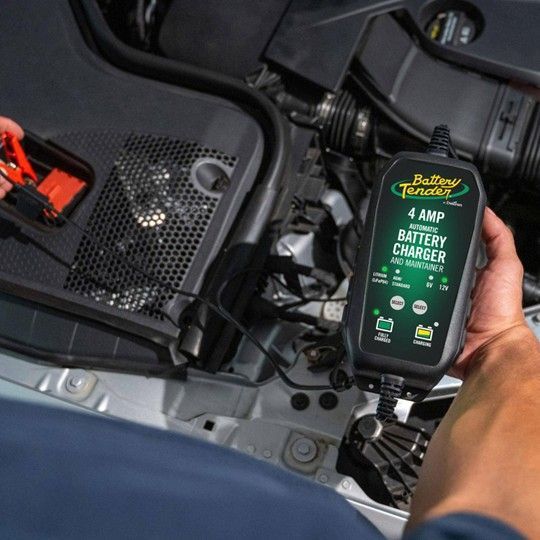
- There are a lot of brands for these; Amazon sells all of them, and, as usual, many are of unknown quality. Schumacker and Battery Tender are two good traditional American brands that have served well. Capacity/size: Some of these units are built for seasonal personal power sports or watercraft and feature very small batteries. Units with less than 2 amps of capacity are geared for those and are too small for car batteries; your car will need one with 3–6 amps. Another reliable source for a good trickle charger is your local parts store; most stores keep these on the shelf. Just remember to ask for the higher 3-6 amp rating. The large ones can cost up to $75 online, and the small ones cost around $35.
- Another option for folks who don’t have easy access to an outlet is a solar charger, with the vehicle parked outside. This is trickier, with a handful of variables that can lead to a purchase that doesn’t work for your car. First, confirm that the car charger (cigarette lighter) port remains powered when the car is shut off, or find another way to connect. It also takes a fairly large panel, approximately 150 sq in, to generate the minimum amps needed to do the job. Then use the same routine once a month: connect this solar charger for a sunny weekend, and it should restore to a full charge. Smaller solar panels should only be considered if you plan to leave it connected all the time, and always park outside.
- Our team can also install a simple harness in the car that makes it easy to connect the charger/maintainer without even raising the hood. Call us to see which option best suits your situation.